Realization of emptiness is the essential criterion for distinguishing the inner paths from the outer ones, the means to attain the supreme fruition of great compassion, and a key qualification for a genuine spiritual teacher. Without realizing emptiness, it is difficult to become a great master capable of truly benefiting sentient beings.
In Praise of Prajnaparamita
Khenpo Sodargye Rinpoche offers a lucid commentary on In Praise of Prajnaparamita, a concise yet powerful hymn composed by the great Indian master Nagarjuna, renowned for his realization of the perfection of wisdom. In two sessions, Khenpo Rinpoche guides us into the heart of Buddhist wisdom. He demonstrates that the realization of emptiness is not merely an abstract philosophy but the very foundation of authentic spiritual practice, compassion, and liberation. Integrating scriptural sources, logical reasoning, and practical advice, he makes this profound wisdom accessible to modern practitioners.
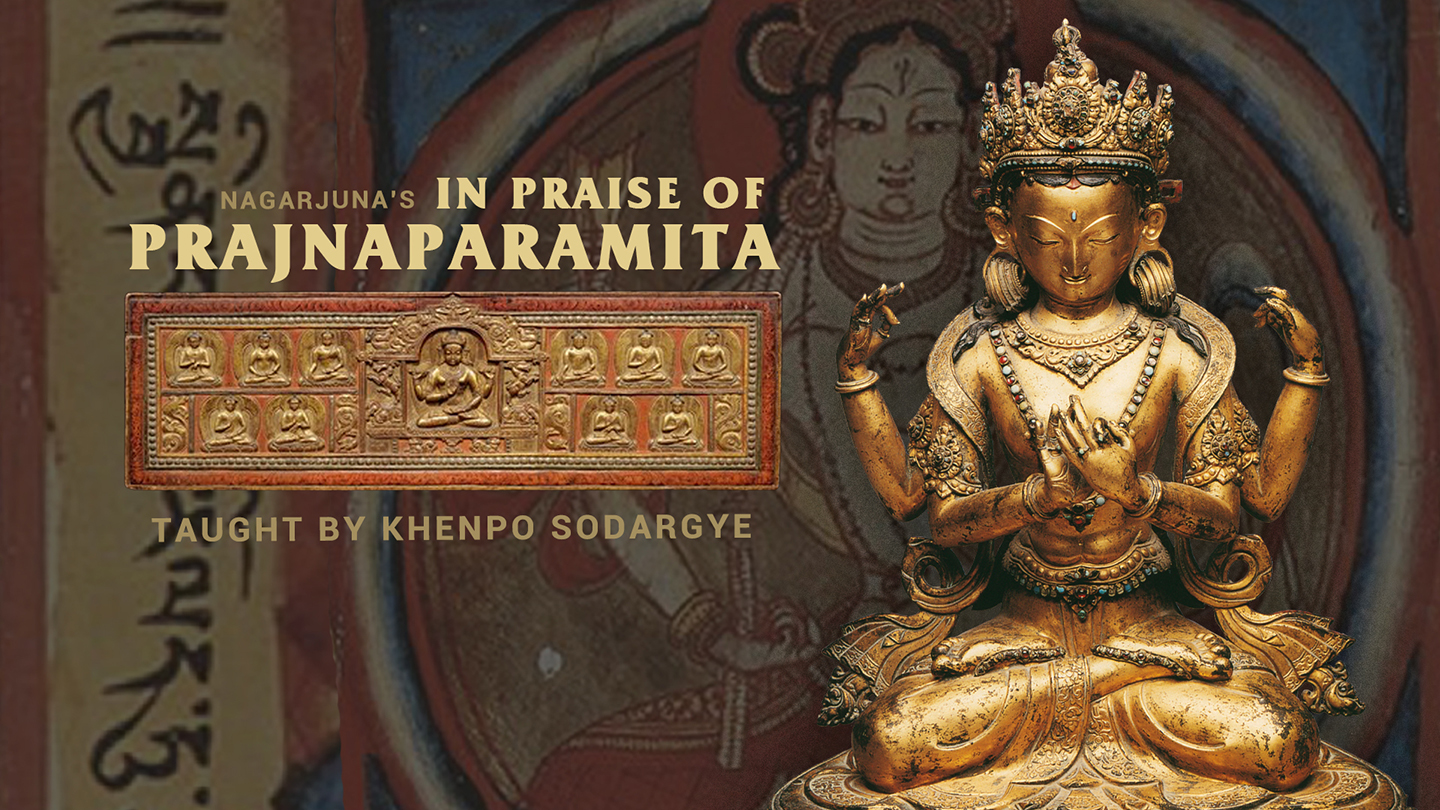
This text praises Prajnaparamita—the wisdom directly realizing emptiness—as the “Mother of the Buddhas,” from whom all enlightenment arises. Through a series of concise and penetrating verses, Nagarjuna extols emptiness as free from all extremes and elaborations, yet as the source from which all awakened qualities unfold. Though brief, the text encapsulates the essential meaning of the Middle Way philosophy. It reveals how Prajnaparamita underlies the six perfections and dismantles all wrong views, thus eradicating suffering and opening the door to ultimate liberation.
When one genuinely realizes the Prajnaparamita, one understands that emptiness itself is ultimately ungraspable—free from the four extremes and the eight conceptual elaborations, with nothing whatsoever to cling to. As the sutras state, “Grasping at existence as vast as Mount Meru is not as harmful as grasping at emptiness as small as a sesame seed.” Those who cling to emptiness cannot be guided, which may lead to unfortunate consequences. Therefore, one should not become attached even to emptiness itself.
Audio Recordings (with simultaneous English translation)
Emptiness has not come from anywhere,
Nor does it go anywhere.
Therefore, under all circumstances,
The wise do not grasp at anything.